
News
2027 election: ADC, PDP await crucial S’Court verdict today
Published 30 April 2026
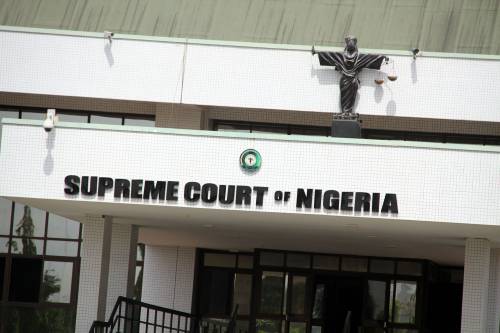
Visual Credits: Echo Archive
The Supreme Court is set to deliver judgment today on the leadership disputes in the African Democratic Congress and the Peoples Democratic Party, a decision that could redefine both opposition parties ahead of the 2027 general elections.
Ahead of the verdict, the party leaders reportedly held an emergency strategic meeting on Wednesday night where they reviewed possible outcomes of the judgment and charted the next line of action for the opposition coalition.
A political commentator, Imran Wakili, confirmed the meeting on his X handle.
“ADC leaders are currently in an emergency strategic meeting ahead of tomorrow’s Supreme Court ruling on the party’s leadership tussle. The closed door meeting is expected to review possible outcomes of the judgment and chart the next line of action for the opposition coalition which has adopted the ADC as its major political platform ahead of 2027. Notably absent from the ongoing high level consultation are Mr. Peter Obi and Senator Rabiu Musa Kwankwaso,” he tweeted.
But in a new development that could further complicate the ADC crisis, a Federal High Court on Wednesday restrained the Independent National Electoral Commission from recognising the ADC congresses conducted by the David Marl leadership pending the resolution of the internal disputes in the party.
Reacting to the judgment, the National Chairman, David Mark, in a statement posted on X (formerly Twitter) by the National Publicity Secretary, Bolaji Abdullahi, assured party members that ADC would be on the ballot for all elections in 2027, despite ongoing legal challenges.
Speaking on Wednesday night after receiving a briefing from the party’s legal team on the Federal High Court judgment, Mark dismissed concerns over the litigations involving the party and expressed confidence in a favourable outcome.“You do not have anything to be afraid of regarding all the litigations before the party.
“I want to assure you that we shall triumph in all the cases, and we shall be on the ballot for every election.
“We are more than prepared and ready for these cases, and we shall do everything within the ambits of the law to surmount every situation.
“In this legal battle, though I am not a lawyer, I will lead from the front, and we shall surely triumph.”
He said the ADC legal team had set in motion the process of appealing the judgment and applied for stay of execution.
Reacting to the verdict, the 2023 ADC Presidential candidate, Dumebi Kachikwu, along with state chairmen of the ADC, expressed their support for the ruling, stating they would not allow the hijacking of the party.
On April 22, the Supreme Court concluded hearings on the leadership disputes involving the ADC and PDP.
The five-member panel of the apex court, headed by Justice Mohammed Garba, did not announce a date for judgment after hearing arguments in separate appeals challenging earlier rulings of lower courts on the issue.
Checks by our correspondents on the official website of the apex court on Wednesday indicated that the matters listed under ‘Political Appeals’ have been added to the cause list for Thursday, April 30, 2026.
The PUNCH also confirmed that judgment in the case of the PDP, with appeal number SC/CV/166/2026, and the ADC matter, marked SC/CV/180/2026, has been fixed for 2pm.
The electoral commission earlier set May 10 as the deadline for political parties to submit their membership registers.
It also scheduled the Presidential and National Assembly elections for Saturday, January 16, 2027, while Governorship and State Assembly elections are fixed for Saturday, February 6, 2027.
According to the timetable, party primaries and the resolution of related disputes will run from April 23, 2026, to May 30, 2026.
Campaigns for the Presidential and National Assembly elections are expected to commence on August 19, 2026, while campaigns for Governorship and State Assembly elections are slated to begin on September 9, 2026.
The scheduled rulings come amid mounting political tension and legal manoeuvres over control of party structures ahead of the 2027 general elections.
The PUNCH reports that the dispute in the ADC centres on a protracted leadership crisis involving Mark, and a rival faction led by Nafiu Gombe.
Mark is challenging the March 12 decision of the Court of Appeal, which directed parties to maintain the status quo in the leadership tussle.
He contended that the appellate court overstepped its bounds, arguing that the dispute is an internal party affair beyond judicial intervention.
The respondents—including the ADC, its National Secretary, Rauf Aregbesola, the INEC and former National Chairman Ralph Nwosu—urged the apex court to dismiss the appeal, insisting the lower court acted within its jurisdiction.
The case was heard on April 22 by a five-member panel led by Justice Mohammed Garba, which subsequently reserved judgment.
In a move that underscored the stakes, counsel for the ADC had earlier written to the Chief Justice of Nigeria, urging the court to deliver judgment within three days.
In the letter dated April 28, 2026, the law firm of S.E. Aruwa (SAN) & Co. warned that any delay could jeopardise the party’s participation in the 2027 polls.
They raised concerns over actions by INEC, alleging that the commission had acted on a lower court ruling to “remove or de-recognise the leadership” of the party.
According to them, the development has left the ADC “without leadership at the moment, even though the ADC remains a recognised registered political party in Nigeria.”
The lawyers further linked the urgency to the electoral timetable already released by INEC, stressing that compliance with statutory requirements for the 2027 elections depends on the outcome of the appeal.
“The ADC’s ability to comply with these statutory requirements to participate in the 2027 general elections is wholly dependent on the timely delivery of the judgment in the instant Appeal,” they said.
They warned that failure to deliver judgment promptly could expose the party to “grave and irreversible risk” of exclusion from the polls, adding that such a scenario would disenfranchise millions of its supporters.
“Justice delayed, in this particular circumstance, would amount to justice denied,” the counsel added, noting that the “entire political future” of the party hangs in the balance.
Expected at the Supreme Court today are Mark, Abdullahi, and other ADC bigwigs.
Also expected are members of the Oyo State Governor, Seyi Makinde’s camp of the PDP, led by Tanimu Turaki (SAN), National Secretary, Taofeek Arapaja, former Niger State Governor, Babangida Aliyu, Publicity Secretary, Ini Ememobong, and others, are also expected to witness the proceedings
From the camp of the Minister of the Federal Capital Territory, Nyesom Wike, those expected at the apex court include the National Chairman, Abdulrahman Mohammed; National Secretary, Senator Samuel Anyanwu; National Organising Secretary, Umaru Bature; and former Jigawa State Governor, Sule Lamido.
Earlier, the Federal High Court in Abuja on Wednesday restrained INEC from recognising or participating in any congress organised by a disputed caretaker leadership of the ADC.
The FHC, in a judgment delivered by Justice Joyce Abdulmalik, also barred former Senate President, Mark, and other prominent figures in the party from interfering with the functions and tenure of the elected state executives.
The ruling is the latest development in the festering leadership dispute within the ADC, with clear implications for the control of party structures ahead of future political activities.
The case arose from an originating summons filed by Norman Obinna and six others on behalf of state chairpersons and executive committees of the party.
The plaintiffs challenged the legality of actions taken by a caretaker or interim national leadership, particularly the move to organise state congresses through an appointed committee.
They argued that the caretaker body lacked the constitutional authority to organise such congresses or to appoint any committee for that purpose.
According to them, only duly elected party organs recognised under the party’s constitution possess the power to conduct congresses.
The plaintiffs, therefore, asked the court to affirm the tenure of the state executive committees and restrain any parallel processes that could undermine their authority.
In resolving the dispute, Justice Abdulmalik held that the claims brought before the court were valid and deserving of judicial consideration, especially in view of alleged breaches of constitutional and statutory provisions. She stated that she found “the issue in the originating summons meritorious.”
The judge framed the central issue as whether the second to sixth defendants, including Mark, had the constitutional or statutory authority to assume the powers of elected state organs of the ADC, whose tenure is guaranteed under the party’s constitution.
She relied on section 223 of the 1999 Constitution, which mandates political parties to conduct periodic elections based on democratic principles, as well as Article 23 of the ADC Constitution, which provides that national and state officers shall hold office for a maximum of two terms spanning eight years.
According to her, “the question is whether there is any infraction committed by Mr Mark and co-defendants when they convened meetings and appointed a body known as a congress committee to organise state congresses.”
On the defence raised by the defendants that the matter was an internal affair of a political party and therefore outside the jurisdiction of the court, the judge acknowledged the settled legal position but clarified its limits.
She held that while courts are generally reluctant to interfere in internal party matters, they will intervene where there is a clear allegation of violation of constitutional or statutory provisions.
“The law is settled that courts will not interfere. However, where there is an allegation of breach of constitutional or statutory provisions, the court has a duty to intervene,” she ruled.
“Where a party alleges that its constitution has been violated, the court is bound to adjudicate. Any argument that this court lacks jurisdiction on that basis fails,” she added.
Abdulmalik stressed that political parties must operate strictly within the confines of their constitutions, noting that any deviation from prescribed procedures, particularly in leadership matters, cannot be justified under the guise of internal autonomy.